Aug. 26, 2026
Quick Answer
The price of an empty intramammary syringe is not determined by capacity alone. A useful quotation must reflect the complete component set, material, tip and cap configuration, color or printing, packing method, sample requirements, order quantity and the way the components will enter the buyer’s filling process. Comparing only the lowest unit price can hide costs that appear
later during filling trials, rework, repacking or specification changes.
1. Why “Price per Syringe” Is Not Enough
When veterinary pharmaceutical companies source an empty intramammary syringe, the first commercial question is often simple: “What is your price?” The problem is that two quotations can show similar unit prices while representing very different supply configurations. One supplier may quote only the basic barrel, plunger and cap in bulk cartons; another may include printing, a specific cap style, component separation, protective inner packing or other project-specific requirements.
For buyers, the better question is: “What configuration is included in the price, and will that configuration work in our filling and packing process?” A quotation becomes commercially meaningful only when the technical and logistical assumptions are clear.
2. Seven Factors That Commonly Change an Empty Intramammary Syringe Quotation
2.1 Capacity and Reference Configuration
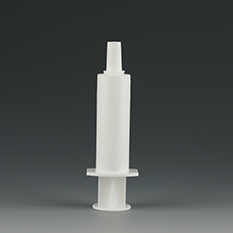
Nominal capacity changes the amount of resin, component dimensions, carton utilization and sometimes the way a syringe interfaces with filling equipment. FUDAPLASTIC currently lists PE intramammary syringe references in 5 ml, 8 ml, 10 ml and 13 ml capacities. The 5 ml G010 and 13 ml G002 are useful reference points, but a buyer should select a size according to the intended fill volume and process rather than price alone.
2.2 Barrel, Plunger, Cap and Applicator-Tip Requirements
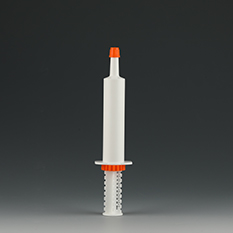
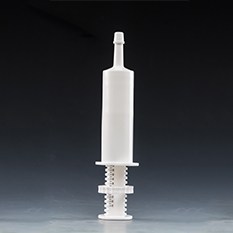
An empty intramammary syringe should be quoted as a defined component system. Differences in cap style, plunger fit, tip geometry or nozzle design can change tooling, assembly, inspection and packing requirements. If a special applicator tip is required, that requirement should be included in the RFQ from the beginning instead of added after the first quotation.
2.3 Color, Printing and Brand Presentation
Standard unprinted components are usually easier to quote than a project that requires a custom barrel color, printed identification, logo position or private-label presentation. Printing also requires agreement on artwork, print area, color standard and inspection criteria. Buyers should separate “standard sample price” from “commercial customized price” so that prototype and production costs are not confused.
2.4 Packing Format
Bulk packing, separated components, pre-assembled parts, inner bags, trays and export-carton arrangements can all affect handling and freight efficiency. The cheapest packaging format is not automatically the best one. A format that creates extra sorting or manual handling at the filling plant can move cost from the supplier’s quotation into the buyer’s production operation.
2.5 Order Quantity and Production Planning
Quotation logic changes with order volume because setup, printing preparation, inspection, packing and production scheduling are spread across different quantities. For a new project, buyers should request both a realistic trial quantity and an expected commercial quantity. This creates a clearer path from sample evaluation to repeat supply.
2.6 Testing, Documentation and Special Handling
Projects may require additional dimensional records, packaging confirmation, sample inspection, sterilization-related documentation or other buyer-specific evidence. These requirements should be listed in the RFQ. If they are added only after price approval, the commercial comparison may no longer be valid.
2.7 Delivery Presentation and Export Logistics
The way empty syringes are packed for export can influence carton count, dimensional weight, component protection and warehouse handling. For international projects, ask the supplier to state the packing quantity per carton, carton dimensions and gross weight together with the commercial quotation. This helps purchasing teams compare landed cost rather than factory price alone.
For current reference configurations, review the Intramammary Syringe product range, compare the 5 ml G010 syringe and the 13 ml G002 syringe before preparing your RFQ.

3. What Buyers Should Put in an RFQ
A clear RFQ improves both quotation accuracy and supplier response speed. It also reduces the risk of receiving prices for configurations that cannot be compared directly. Before requesting a quotation, prepare the following information:
• Target fill volume and preferred syringe capacity
• Application category and approximate formulation characteristics relevant to filling
• Required barrel, plunger, cap and applicator-tip configuration
• Filling method and any important machine-interface information
• Color, printing, label or artwork requirements
• Bulk or individual packing preference
• Sterilization or documentation requirements, if applicable to the project
• Sample quantity, trial quantity and estimated commercial demand
• Target market and required delivery destination
4. Where “Cheap” Can Become Expensive
A lower quoted unit price can lose its advantage if the buyer later discovers that the chosen component arrangement requires manual sorting, does not run smoothly on the intended filling line, needs repacking, or requires a redesign of the tip, cap or print layout. These are not theoretical purchasing issues; they are project-integration issues. The best commercial decision is therefore the quotation that gives the buyer the clearest path to filling trials, approval and repeat ordering.
This is also why samples should be evaluated against the same configuration expected for production. If the sample and bulk configuration are materially different, the sample result does not provide a reliable basis for the final commercial decision.
5. How FUDAPLASTIC Can Support a More Accurate Quotation
FUDAPLASTIC supplies empty intramammary syringe packaging for veterinary pharmaceutical filling projects. The current product range includes 5 ml, 8 ml, 10 ml and 13 ml PE references, with project discussions covering component structure, applicator tip, cap, plunger, color, printing and packing options. Buyers can use the published product references as a starting point and then provide their filling and commercial requirements for a more focused quotation.
For a quotation that is easier to compare internally, send the target capacity, component configuration, sample quantity, estimated order quantity, customization needs and delivery destination. Contact FUDAPLASTIC to discuss the project and request samples or pricing.
FAQ
What information is needed to quote an empty intramammary syringe?
At minimum, provide the preferred capacity, component configuration, sample or order quantity, color or printing requirements, packing preference and delivery destination. Filling-method information is also useful when component presentation may affect production.
Does a larger intramammary syringe always cost more?
Not necessarily in a simple linear way. Capacity can influence material use and packing density, but customization, quantity, packing format and project requirements may have a greater effect on the final quotation.
Can I request a price for 5 ml and 13 ml options at the same time?
Yes. Comparing defined references can help buyers evaluate capacity and project fit. FUDAPLASTIC lists the 5 ml G010 and 13 ml G002 as current product references.
Should I ask for samples before placing a bulk order?
Yes. Sample confirmation is recommended before bulk production, especially when the syringe will be evaluated with a specific filling process, formulation and packing workflow.
Does FUDAPLASTIC supply finished veterinary medicine?
No. The intramammary syringes discussed here are supplied as empty packaging components and do not contain medicine or active pharmaceutical ingredients.

 冀ICP备11016487号-1