Sep. 10, 2026
Quick Answer
For a private-label empty intramammary syringe project, define the full packaging configuration before requesting final samples: target capacity, barrel and component colors, printing or label area, cap and applicator-tip structure, plunger requirements, bulk or individual packing, and the approval process for artwork and production samples. A clear specification reduces quotation revisions, shortens sample cycles and helps the supplier prepare a configuration that can move more smoothly into filling and commercial production.
1. Private Label Is More Than Printing a Logo
For veterinary pharmaceutical companies, animal-health brands and distributors, an empty intramammary syringe may become part of the visible identity of the finished product. The barrel color, printed information, cap appearance, applicator-tip geometry and outer packing can influence how the final product is recognized, handled and differentiated in the market.
Because of this, a private-label project should not begin with artwork alone. The buyer first needs to define the physical syringe configuration. Artwork can only be finalized after the capacity, component structure, available print area and packing format are understood.
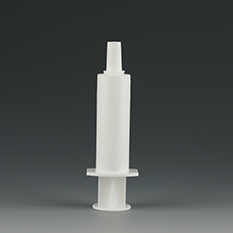
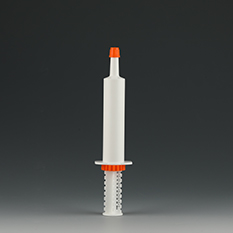
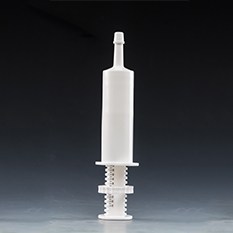
FUDAPLASTIC currently lists 5 ml, 8 ml, 10 ml and 13 ml PE empty intramammary syringe options. The product family is supplied as empty packaging and can be discussed for project-specific requirements such as barrel capacity, applicator tip, cap, plunger, color, printing and bulk packaging.
2. Start With the Base Syringe Configuration
Before discussing branding, confirm the base container that fits the project. Nominal capacity is the first decision, but it should be reviewed together with filling volume, formulation behavior, filling direction, equipment interface and the space needed for printing or labeling.
2.1 Capacity and Dimensions
If the project is close to a 5 ml format, review the 5 ml intramammary syringe (G010). For larger-fill projects, the 13 ml intramammary syringe (G002) provides a larger reference format. Buyers should compare the published dimensions with their own filling and handling requirements rather than selecting by capacity name alone.
2.2 Cap, Plunger and Applicator Tip
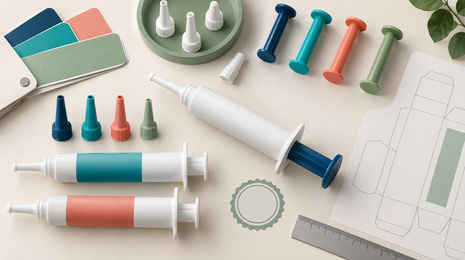
The cap, plunger and applicator tip should be treated as functional components, not decorative accessories. A branding decision that changes color or style should not compromise fit, closure, plunger travel or the intended filling sequence. When requesting customization, specify which component may change and which dimensions or interfaces must remain fixed.
3. Define the Branding Specification Before Artwork Approval
A useful private-label brief should separate visual requirements from functional requirements. This makes it easier for the supplier, filling team and brand team to review the same project without mixing artwork changes with engineering changes.
Barrel color: Specify standard or custom color expectations and whether transparency or content visibility matters.
Printing area: Define the required logo, text, batch-information zone or decoration area and confirm the usable print surface.
Cap and plunger color: State whether components should match the barrel, contrast with it or follow a product-family color code.
Brand hierarchy: Identify which information is permanent artwork and which information will be added later by label, inkjet or secondary packaging.
Language and market versions: If multiple markets are involved, define whether one universal syringe design or multiple artwork versions will be required.
4. Packaging Format Can Affect the Private-Label Project
Private-label buyers often focus on the syringe itself and leave transport packaging until the end. That can create avoidable changes. Bulk packing, component separation, protective inner bags, carton quantity and the way parts are presented to the filling line can all affect handling efficiency and the visual condition of components when they arrive.
For example, a distributor may prioritize compact export cartons and clear batch identification, while a contract filler may prioritize component orientation and line-side handling. These are different operational needs, even when the syringe itself is identical.
Empty Intramammary Syringe
5. Build an Approval Sequence That Prevents Rework
A structured approval sequence helps prevent the common situation in which artwork is approved first and then has to be redesigned after the physical sample changes. A practical sequence is:
1. Confirm application, target capacity and filling method.
2. Select the base syringe model and component structure.
3. Confirm component colors and any structural customization.
4. Confirm printable or labelable area.
5. Prepare artwork according to the approved physical sample.
6. Review pre-production or decorated samples.
7. Approve final packing configuration and commercial production specification.
6. FAQ
Can FUDAPLASTIC discuss customized empty intramammary syringe projects?
Yes. The current product information lists project options including barrel capacity, applicator tip, cap, plunger, color, printing and bulk packaging. Final feasibility should be confirmed against the buyer’s specific project.
Which capacities are currently listed?
The current intramammary syringe product family lists 5 ml, 8 ml, 10 ml and 13 ml PE options.
Should artwork be finalized before physical samples?
Usually, the physical configuration and available decoration area should be confirmed first. This reduces the risk of redesigning artwork after the syringe or component structure changes.
Can a buyer request different component colors?
Color requirements can be discussed as part of a customization project. The buyer should identify which components require color differentiation and any visual or functional constraints.
What information helps FUDAPLASTIC respond faster?
Send the target capacity, filling method, component configuration, color/printing needs, packing preference, sample quantity, estimated order volume and target market.
7. Turn a Branding Idea Into a Clear Packaging Specification
The strongest private-label projects translate brand ideas into a controlled technical specification. For an empty intramammary syringe, the objective is not simply to make the syringe look different. The objective is to create a configuration that is recognizable, manufacturable, compatible with filling, practical to pack and consistent enough for repeat commercial supply.
Preparing a new project? Send FUDAPLASTIC your target capacity, filling method, preferred component colors, printing or label requirements, packing format, sample quantity and estimated order volume. Contact FUDAPLASTIC to request samples, confirm available configurations and obtain a project-specific quotation.
Previous: None

 冀ICP备11016487号-1