Jul. 30, 2026
Introduction
An empty intramammary syringe is more than a plastic container. It is a primary packaging and delivery component that must function consistently during filling, storage, transport, and end use. Barrel dimensions, plunger movement, nozzle geometry, cap closure, material selection, sealing performance, and printability can all affect the success of a veterinary pharmaceutical project.
For this reason, requesting samples should not be the first step in supplier selection. A professional buyer should first determine whether the supplier has the systems, technical capability, and communication discipline required to support the project beyond the initial sample stage. Supplier qualification reduces the risk of selecting a syringe that performs well in a small trial but creates problems during filling validation or commercial production.
Why Supplier Qualification Matters
Supplier qualification converts purchasing from a product comparison into a controlled project decision. It helps buyers distinguish between a supplier that can provide a few acceptable samples and a supplier that can repeatedly manufacture the same components under defined controls.
For an empty intramammary syringe project, qualification is especially important because the component interfaces with filling equipment and may be used for dairy animal health products such as mastitis treatment packaging, dry cow therapy packaging, or teat sealant packaging. The syringe is supplied as empty packaging and does not contain medicine or active pharmaceutical ingredients. Its suitability must therefore be evaluated against the buyer’s own formulation, filling process, regulatory strategy, and target market.
1. Confirm the Supplier’s Quality and Manufacturing Foundation
Start with the supplier’s legal identity, manufacturing location, quality-management system, production experience, and product scope. Ask who actually molds, assembles, inspects, packs, and releases the syringe. This prevents confusion between a manufacturer, a trading company, and a supplier that outsources critical processes without transparent controls.
Review the quality documentation relevant to your project. Depending on your market and internal requirements, this may include quality certificates, inspection procedures, material information, batch traceability, change-control practices, nonconformance handling, and available sterilization documentation. Certification alone is not enough; the buyer should also understand how controls are applied to the specific syringe family.
2. Define the Technical Requirement Before Sample Selection
A sample request should be based on a written specification rather than a general request for an ‘intramammary syringe.’ At minimum, define the target capacity, filling direction, filling-machine interface, barrel and nozzle dimensions, plunger travel, cap type, required color, printing area, packing method, and whether sterilization is required.
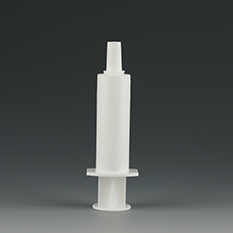
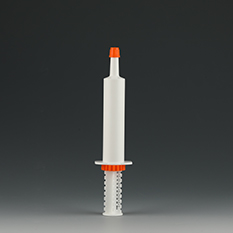
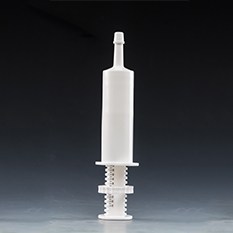
FUDAPLASTIC currently lists four capacities in its intramammary syringe range: 5 ml, 8 ml, 10 ml, and 13 ml. The 5 ml model is reference G010, while the 13 ml model is reference G002. Buyers should use the published dimensions as a starting point and then confirm tolerances and critical-to-quality dimensions against their own filling and application requirements.
3. Evaluate Material and Component Consistency
Material consistency matters because it can influence dimensional stability, plunger movement, sealing, appearance, and compatibility with processing conditions. Confirm the material used for the barrel, plunger, and cap, and ask whether the supplier controls resin grade, approved sources, incoming inspection, and material changes.
The component set should also be reviewed as a system. A barrel cannot be assessed independently from the plunger and cap. Ask how the supplier controls fit, insertion force, movement, closure retention, leakage risk, and dimensional variation across production batches. For custom color or printing, define visual standards and acceptance criteria before approving the sample.
4. Review Filling and Assembly Compatibility
Technical review should reflect the actual production process. Confirm whether filling is planned from the barrel tip or from the bottom of the tube, and share relevant filling-machine information with the supplier. A dimensional drawing, equipment interface description, or existing reference sample can reduce misunderstandings.
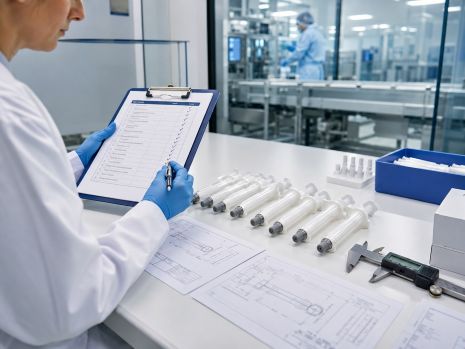
During sample evaluation, test more than appearance. Assess feeding and orientation, filling accuracy, plunger insertion, cap application, leakage, smoothness of movement, print adhesion, packing presentation, and any handling characteristics important to the intended use. Record test conditions so that the approved result can later be compared with pilot and production batches.
Empty Intramammary Syringe
5. Check Documentation, Change Control, and Supply Reliability
A technically acceptable sample is not sufficient if the supplier cannot support documentation or stable delivery. Confirm which documents can accompany samples and commercial orders, how batches are identified, how inspection records are retained, and how product or process changes are communicated.
Supply reliability should include capacity, lead time, tooling ownership where applicable, backup equipment, raw-material availability, packaging supply, export experience, and response time for quality issues. Buyers should also clarify the commercial terms that affect continuity, including minimum order quantity, sample policy, quotation validity, payment terms, and packaging configuration.
6. Build a Clear Sample Approval Plan
Before samples are shipped, prepare a sample approval sheet with measurable acceptance criteria. Divide the review into visual, dimensional, functional, filling-line, packaging, and documentation sections. Identify which results are mandatory, which are preferred, and who has authority to approve the sample.
A structured approval plan avoids a common procurement mistake: approving a sample informally and discovering later that different departments expected different performance. Quality, engineering, production, regulatory, and purchasing teams should review the same requirements. Any deviation should be recorded and resolved before the project moves to pilot or bulk production.
Conclusion
Supplier qualification protects an empty intramammary syringe project from hidden risks that are not visible in a sample photograph or initial quotation. The strongest process confirms the supplier’s quality foundation, defines technical requirements, checks product parameters, evaluates real filling compatibility, and establishes documented approval criteria.
FUDAPLASTIC offers empty intramammary syringe packaging in multiple capacities for veterinary pharmaceutical filling projects. Buyers can review the product range, compare the 5 ml and 13 ml models, and contact the team with their capacity, filling method, target market, and sample-evaluation requirements.
FAQ
What should be confirmed before requesting empty intramammary syringe samples?
Confirm capacity, reference model, filling method, critical dimensions, cap and plunger requirements, material, color, printing, packing, sterilization needs, target market, and sample acceptance criteria.
Is a sample approval enough to qualify a supplier?
No. Sample approval confirms the tested pieces, while supplier qualification also evaluates quality systems, process controls, documentation, change management, and repeatable supply capability.
Which capacities are available from FUDAPLASTIC?
The current product page lists 5 ml, 8 ml, 10 ml, and 13 ml empty intramammary syringe options.
What are the references for the 5 ml and 13 ml models?
The 5 ml model is G010, and the 13 ml model is G002.
Should filling compatibility be tested?
Yes. Buyers should evaluate the syringe with the intended filling method and equipment whenever possible, including feeding, filling, plunger insertion, cap application, and leakage performance.
Does FUDAPLASTIC supply finished veterinary medicine?
No. The product is supplied as empty packaging and does not include medicine or active pharmaceutical ingredients.
Call to Action
Preparing an empty intramammary syringe project? Send FUDAPLASTIC your target capacity, filling method, dimensions, sample quantity, and market requirements to begin a focused technical review.

 冀ICP备11016487号-1