Jul. 14, 2026
For veterinary pharmaceutical filling projects, formulation viscosity is not only a formulation property. It directly affects how an empty intramammary syringe fills, seals and dispenses. A syringe that operates smoothly with a low-viscosity liquid may require significantly more force when used with a dense paste or teat sealant. This is why packaging selection should be based on formulation-specific testing rather than nominal capacity alone.
The practical question is not simply, “Which syringe size fits the dose?” It is: “Can this syringe deliver this formulation consistently under the expected filling, storage and dispensing conditions?”
Why Viscosity Cannot Be Treated as a Single Fixed Number
Formulation viscosity may change with temperature, storage time and shear rate. Some pastes become easier to move once force is applied, while others remain highly resistant throughout dispensing. A formulation tested only at room temperature may behave differently after cold storage or after remaining in the filled syringe for an extended period.
For this reason, early screening should evaluate more than one condition. Useful comparisons may include the formulation at the lowest expected use temperature, at normal room temperature and after exposure to the upper end of the expected storage range. These tests are not a substitute for formal product validation, but they can identify obvious packaging mismatches before a commercial filling trial.
Where Dispensing Force Comes From
The force required to move product through a syringe generally comes from two sources: friction between the barrel and plunger, and flow resistance as the formulation passes through the outlet. A narrow nozzle, a long flow path or a highly viscous formulation can increase resistance. The initial force needed to start the plunger may also differ from the force needed to keep it moving.
General syringe-delivery research - not specific to intramammary products - shows that viscosity and flow-path geometry influence expulsion force. This principle is useful when screening veterinary packaging, but the final decision must still be based on testing with the actual formulation and the selected syringe configuration. Technical reference: Understanding Syringeability and Injectability of High-Viscosity Formulations
Four Performance Signals to Watch During Sample Testing
1. Excessive Start-Up Force If the plunger is difficult to start, the user may apply a sudden high force. This can cause an abrupt discharge instead of a controlled flow. Record the initial break-loose behaviour separately from the force required during the rest of the stroke.
2. Uneven or Interrupted Flow Pulsing, hesitation or sudden acceleration may indicate that the formulation and outlet geometry are not well matched. These effects can become more visible with high-viscosity or non-uniform formulations.
3. High Product Retention After dispensing, inspect the barrel, plunger face and nozzle. Excessive residue can affect delivered quantity and may indicate that the internal geometry or formulation behaviour needs further evaluation.
4. Leakage or Cap Contamination High filling pressure, trapped air or product migration into the tip area can interfere with closure. Check the cap, nozzle and package after filling, simulated transport and storage screening.
Capacity and Nozzle Geometry Must Be Evaluated Together
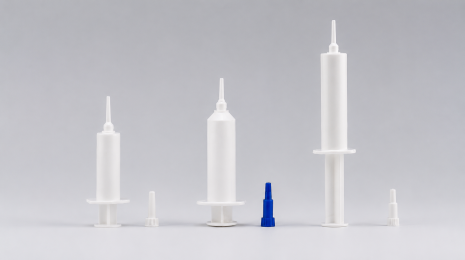
Capacity determines how much product the barrel can hold, but it does not by itself determine dispensing performance. A smaller barrel may have a different internal diameter, stroke length and outlet geometry from a larger version. These differences can change both user force and residual product.
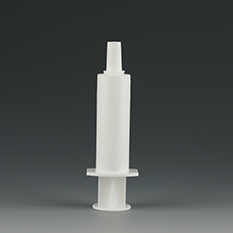
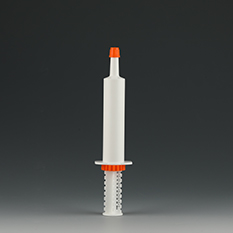
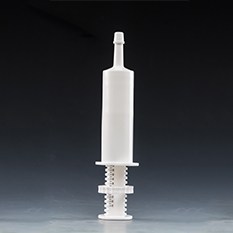
Xinfuda lists several PE options within its empty intramammary syringe range. For projects requiring a compact fill volume, buyers can review the 5ml intramammary syringe. For higher nominal capacity, the 13ml intramammary syringe provides a different dimensional reference. These links support preliminary comparison only; suitability for a specific paste, gel or sealant must be confirmed through sample testing.
A Practical Screening Matrix for Filling Trials
A structured test plan helps the formulation team, filler and packaging supplier discuss results using the same evidence. The following matrix can be adapted for early-stage screening:
| Test condition | What to record | Why it matters |
| Temperature | Formulation and syringe temperature at testing | Viscosity and dispensing force may change with temperature |
| Start-up force | Whether the plunger starts smoothly or releases suddenly | Identifies break-loose or sticking concerns |
| Stroke behaviour | Smooth, pulsing, interrupted or accelerating flow | Shows consistency during dispensing |
| Dispensing time | Time required at a defined operator speed or test method | Allows comparison between samples |
| Residual product | Visible residue in barrel, plunger face and nozzle | Highlights delivery and geometry issues |
| Closure condition | Cap fit, tip contamination and leakage after filling | Checks interaction between filling and closure |
| Storage screening | Performance after selected time and temperature conditions | Detects changes that are not visible immediately after filling |
Information to Send the Packaging Supplier
To reduce unnecessary sample rounds, provide the supplier with practical formulation and process information. A useful inquiry package includes:
· Target filling volume and acceptable headspace
· Approximate viscosity or a clear low/medium/high viscosity description
· Whether the product behaves differently at low temperature
· Manual, semi-automatic or automatic filling method
· Preferred filling direction and component supply format
· Target dispensing time or acceptable user force, if available
· Tip, nozzle and cap requirements
· Expected storage and transport conditions for the filled product
When exact rheology data are not available, sending a representative formulation sample for controlled testing may be more useful than relying on a broad description such as “paste” or “gel.”
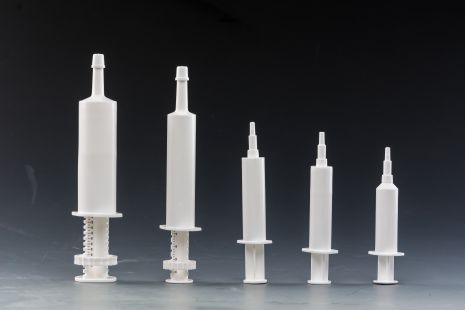
Veterinary Syringe Set
Frequently Asked Questions
Does a higher-capacity syringe handle high-viscosity products better?
Not necessarily. Capacity, barrel diameter, plunger fit, nozzle geometry and formulation behaviour must be evaluated together.
Can water be used instead of the real formulation for a filling test?
Water can help check basic assembly or leakage, but it cannot represent the force and flow behaviour of a viscous veterinary formulation.
When should the syringe configuration be finalized?
After the formulation, filling method, outlet design and closure performance have been screened together using representative samples.
Discuss a Formulation-Specific Syringe Trial
An empty intramammary syringe should be evaluated as part of a complete formulation-and-packaging system. Capacity selection is only the starting point. Viscosity, temperature, plunger friction, outlet geometry, filling pressure and closure condition all influence the final result.
To request samples or discuss a screening trial, contact Xinfuda with your target volume, formulation type, filling process and preferred tip configuration.

 冀ICP备11016487号-1