Apr. 09, 2026
As the demand for home self-injection(especially prefilled injector pen) and high-precision drug delivery continues to rise, the injector pen has gradually become a core choice for medical institutions and patients, while the traditional syringe still plays an irreplaceable role in specific scenarios. The following is a comprehensive analysis of injection pens and syringes to help pharmaceutical companies, distributors, and medical institutions quickly find the best dosing regimens.
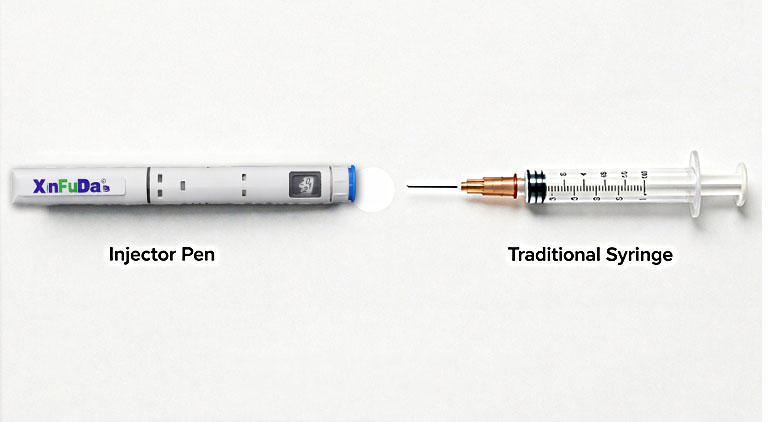
Injector Pen and Syringe Comparison Cover
Syringe: - Process: Manual extraction of medicinal liquid, needle replacement, and air bubble removal are required. - Pain Points: The procedure is cumbersome, making it difficult for beginners or individuals with poor eyesight. Additionally, there is a risk of medicinal liquid exposure during preparation, and the process is time-consuming.
Injector Pen: - Process: Ready to use straight out of the box with no drug preparation required; the prefilled injector pen is more convenient due to its pre-installed liquid.
- Advantages: One-click operation minimizes human error, making it ideal for home self-injection (e.g., diabetic patients). It is user-friendly and causes less psychological stress compared to traditional syringes.
Reason: Improved sentence structure and clarity by breaking up long sentences and enhancing word choice. Corrected punctuation and capitalization for consistency and readability.
Syringe: - Accuracy: Depends on the operator's skill and eyesight; the dosing error can be relatively large, making it suitable for applications with broad dose requirements.
- Compatibility: Widely compatible with powders, low-viscosity liquids, and temporarily prepared medicinal solutions.
Injector Pen: - Accuracy: The precision mechanical structure (0.5 µL/1 µL increments) ensures accurate dosing, reducing the risk of hypoglycemia or overdose.
- Compatibility: Designed for high-viscosity biologics such as insulin and GLP-1, it addresses syringe push difficulties. The prefilled injector pen minimizes liquid waste and is cost-effective over the long term.
| Dimensions | Syringe | Injector Pen (Prefilled) | Decision Suggestions |
| Initial Investment | Low (primarily material costs) | High (including pen device and prefilled drug core) | Choose syringe if focusing on unit price; choose injector pen if focusing on overall curative effect |
| Long-term Cost | High (high consumable loss and medicinal liquid waste) | Low (automatic filling, zero waste) | Under large-scale long-term procurement, the comprehensive cost of injector pen is more optimal |
| Supply Chain | Mature, low threshold, fierce competition | High threshold, relying on GMP automated production to ensure injector pen quality; strict supply chain control and GMP production are key for market access. | Suppliers with production capacity have more bargaining power |
- Syringe: Manufactured according to mature production standards (ISO 7886, GMP), suitable for low-viscosity medications, and widely used in basic medical settings. - Injector Pen: A high-end precision device requiring FDA and CE certification (MDR). Safety features such as anti-leakage and anti-mis-touch designs enhance its advantages over syringes.
- Your product is a traditional medicine with low viscosity or a powder medicine.
- The project budget is very tight, and the requirement for operational efficiency is low.
- It is targeted at the basic medical market or regions that are highly sensitive to cost.
- Your product is a high-end biologic, insulin, or a high-viscosity drug.
- The target customers are hospitals, high-end clinics, and brands focused on enhancing the patient experience.
Whether it is an injector pen or a syringe, the core value lies in safety and efficacy.

 冀ICP备11016487号-1