Apr. 22, 2026
Auto-injectors and pen injectors both deliver medication subcutaneously but are designed for different purposes. Pen injectors, commonly used for insulin therapy, are better suited for frequent, adjustable daily dosing. In contrast, auto-injectors provide one-click, automatic delivery, making them more suitable for emergency situations, infrequent use, or high-viscosity medications. This distinction helps both users and pharmaceutical companies and distributors select the most appropriate solution.
In addition, it addresses two core questions: Auto-injector vs. pen injector— which is better for insulin therapy, and auto-injector vs. pen injector— which is more suitable for promotion.
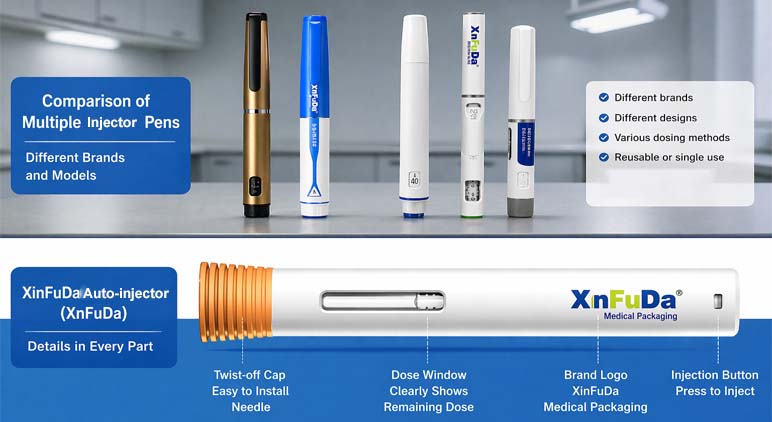
Auto-Injector vs. Pen Injector
- Cost-effective and suitable for long-term daily use by patients.
- Manual dose adjustment allows for flexible, personalized medication management.
- Lightweight and portable, making it easy to carry in daily life.
- Simple structure, low maintenance, and minimal after-sales costs
- One-button operation requires no manual injection, reducing the risk of operational errors.
- Built-in safety mechanism to prevent accidental needle sticks.
- Precise dosing to ensure consistent medication delivery.
- Suitable for patients with limited dexterity, such as the elderly and disabled.
- Operation Mode: The pen injector requires manual pressing, whereas the auto-injector completes the injection with a single button press.
- Safety: The auto-injector features a safety needle retraction design, whereas the pen injector lacks this function.
- Dosing Precision: The auto-injector minimizes manual errors, whereas the pen injector depends on user operation.
- Applicable Groups: Pen injectors for general patients; auto-injectors for elderly or disabled patients.
For insulin therapy, an auto-injector is more suitable for patients with limited dexterity, as its one-button operation simplifies the injection process. A pen injector is preferable for patients who require flexible dose adjustments and long-term cost control. Overall, when comparing auto-injectors and pen injectors, there is no definitive answer as to which is better for insulin therapy; however, both devices effectively support insulin delivery.
For pharmaceutical companies and distributors, the key question is whether an auto-injector or a pen injector is more suitable for B-end promotion. Auto-injectors offer higher added value and greater customization potential, making them ideal for bundling with high-end drugs. Pen injectors, on the other hand, are cost-effective and widely accepted, making them suitable for mass promotion in retail pharmacies. The choice between auto-injectors and pen injectors also depends on channel positioning: hospitals prefer auto-injectors for their safety features, while community pharmacies favor pen injectors due to their lower cost.
In summary, pen injectors and auto-injectors differ in operation, safety, and applicability. When considering insulin therapy, the choice between an auto-injector and a pen injector depends on the patient's specific needs. Meanwhile, determining which device is more suitable for B-end promotion depends on the channel positioning and product positioning of pharmaceutical companies and distributors stakeholders. Both devices effectively support medication delivery, enabling users and B-end partners to make optimal choices.

 冀ICP备11016487号-1